Access Control in Sunnyvale
Street gates and operators, call boxes, keypads, lobby fob readers, maglocks, request-to-exit sensors, elevator floor restriction, garage clickers, and fob enrollment or de-enrollment when a tenant arrives or leaves. Priced on the call at $149 to $429, not sent off for a quote. Shared openings are ordered by the manager, the owner or the HOA.
4.9 / 5· 371 reviews from Sunnyvale and the towns beside it
$149–$429
Typical price
21 min
Avg. arrival
24/7
Availability
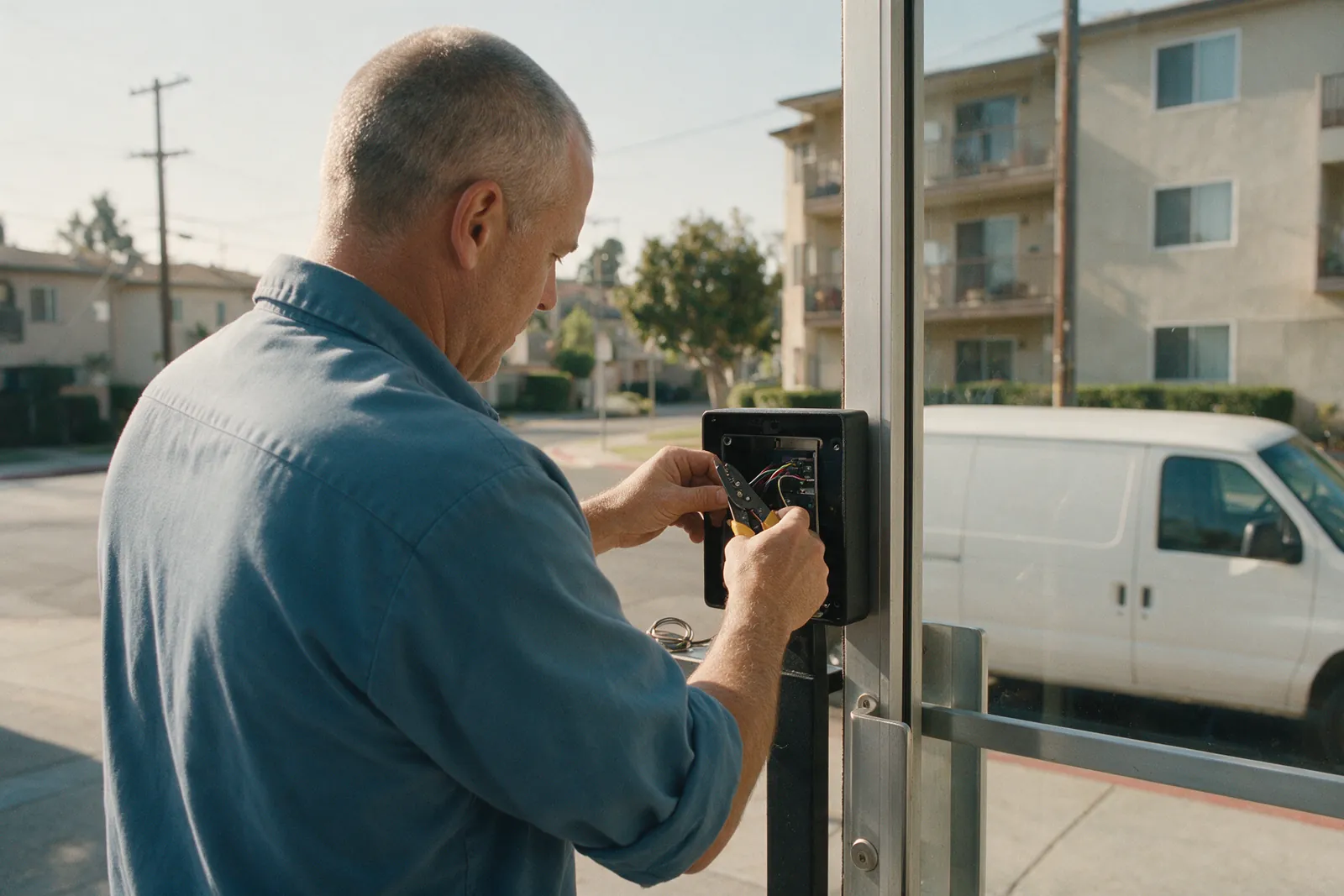
In this city half the doors are not doors. More people reach their own bed through a street gate, a lobby reader, a garage clicker and an elevator than through a front door on a street, and any one of those can be the thing standing in the way at one in the morning. That is why access work is a first-class service here rather than a footnote under commercial. A vehicle gate off Fair Oaks Avenue that stopped opening for anyone after a power blip. A call box in a Wolfe Road lobby that has rung the wrong apartment since the panel was last rewired. A maglock gripping so hard that people have learned to walk at the door twice. A garage clicker that went silent when the receiver board was swapped. An elevator that ought to serve the fourth floor for fourth-floor residents and does not. A fob that has to stop working tonight because the tenant it belonged to handed back the keys this afternoon. The van carries readers, strikes, gate boards and fob stock alongside cylinders, and the figure covers whichever of them is actually stopping you.
The street gate comes first, because that is where people are standing when they call. A vehicle gate is an operator, a control board, a receiver for clickers, safety loops and edges, and usually a call box with a keypad on a post beside it. Faults sort into a short list: a board killed by a surge, a receiver that has lost its stored codes, a keypad whose backlight and memory went together, a safety loop reading standing water as a car, a backup battery that has not held charge since last winter. Each is diagnosed at the post rather than guessed at, and when a board has genuinely failed it is replaced and the clicker codes are written back in so residents are not left holding dead remotes. Call boxes get a session of their own. On a building whose wiring has passed through three sets of hands, each button is pressed and traced to the apartment it truly reaches, then the directory is rebuilt around the numbers on the doors, which is what stops visitors buzzing four households before they find yours.
Inside the building the hardware changes. A lobby door in a steel or timber frame with depth behind it takes an electric strike. A glass and aluminum lobby door with a narrow stile has nowhere to put one, so a magnetic lock goes at the head of the frame where there is metal to fix to, and that choice brings a request-to-exit sensor with it: a motion head above the door on the inside, or a push-to-exit button on the wall, wired so anyone heading out drops the magnet before they reach the handle. A maglock without a working exit sensor is a trap, and a good share of these calls turn out to be exactly that. Fob readers are mounted, run back to the controller and proved from both faces. Garage clickers are enrolled at the receiver and dead ones cleared out. Elevator floor restriction puts a reader in the cab with a relay per floor, so a credential calls the floors it is entitled to and no others, which is how a fourth-floor resident reaches four while a courier reaches the lobby. One opening in every building keeps a mechanical cylinder on a restricted key, because a site with no metal route in is a single outage away from shutting itself out.
Authority decides what can be done and it is worth stating plainly. Your fob is yours: a resident can ask for a replacement fob for their own unit and it is enrolled against that unit. Your unit door is yours as well. Everything shared belongs to the building. The gate, the lobby, the garage, the parcel room, the amenity rooms, the elevator and the credential list itself are commissioned by the building manager, the owner or the HOA, and the figure and the receipt go to whoever commissioned the work. When a tenant leaves, de-enrolment is a manager instruction rather than a departing tenant one, and it is best booked for the day the keys come back rather than the following week, because a credential still sitting on the list opens the gate at midnight exactly as it did before. Where a manager wants it, the fob list and the master key chart are written to agree, so one move-out closes both sides in a single visit.
This work is priced here rather than waved off as a custom quote: $149 to $429, with the $89 service call inside the figure. The $149 end covers a service visit on one opening: enrolling fobs, de-enrolling a tenant who has left, clearing and rewriting garage clicker codes, rebuilding a call box directory, swapping a failed keypad, re-aiming a request-to-exit sensor that has drifted. The middle covers a reader or keypad supplied and fitted to an existing opening, a strike replaced, a gate control board changed and the clickers written back in. The $429 end covers an opening built from nothing on one door, meaning reader outside, maglock or electric strike, exit sensor, power and the cable run tying them together, or an elevator reader with its floor relays. Evening work at the low end is $199 and overnight is $234, both already carried inside the number you hear. A building with many openings is still priced this way, one line per opening, so a manager can see what each is costing instead of receiving one number for the site.
You call and say which opening it is and what it is doing: gate, call box, lobby door, garage receiver, elevator or a single fob, and whether you live there or run the place. The figure is said on the call, with the overnight hour already inside it, which matters on this page more than most, because gates fail at the hour people come home. The van leaves Moffett Park and a text names the technician and a thirty-minute window, fifteen to twenty-three minutes across Sunnyvale and longer only past the city line. Every opening worked on is proved from outside with a credential and from inside against the exit sensor, every call box button is rung through to its apartment, and the handover has you adding a fob, removing one and setting a schedule on the screen yourself while the technician is still there. The figure on the receipt is the figure from the call, opening by opening.
“Twenty to three in the morning, our street gate stopped halfway and wouldn't go either direction, so half the building couldn't get their cars off the sidewalk and the rest couldn't get out for a six a.m. shift. $296. Our gate contractor had quoted $850 and a Thursday appointment. I'm the on-site manager, so the authorization was mine to give, and the locksmith said so before he unbolted anything. The operator board had a failed relay and a loop lead that had been nicked at some point. He had the gate closing properly before four and left the old board in a bag on my desk!”
“Our parcel room reader stopped taking fobs the week a delivery backlog piled up in the lobby, and we also had eleven fobs still enrolled for people who moved out in the fall. $268 for the reader and the enrollment work as one figure. The tech sat with our panel and cleared the eleven, then handed back a printed list of what was live and what he had removed, unit by unit. Our HOA board signed off before he started because the parcel room belongs to all of us, and he was the one who raised that, not us.”
Every job is priced from the list below, including the access work most locksmiths quote instead of pricing. Say which opening it is and the figure is settled on the call, with the after-hours hour already inside it.
- Daytime (7am–8pm)standard rates
- Evening (8pm–12am)+$50
- Overnight (12am–7am)+$85
FAQ
Access Control: quick answers
I rent off Fair Oaks Avenue and my fob has stopped working at the gate. Can I book this myself?+
For your own fob, yes. A resident can arrange a replacement or a re-enrolment for the credential tied to their own unit, and that sits at the $149 end of the range. What a resident cannot order is a change to the gate itself, to the lobby reader, to garage receiver programming or to the credentials other households hold, because those are shared and belong to the building manager or the HOA. If the whole gate is dead rather than your fob alone, report it and pass this number on, since the manager can authorize the repair in one call.
A tenant moved out this afternoon and still has a fob and a garage clicker. How fast can both be shut off?+
Same day, and same day is the right answer rather than the end of the week. The fob is struck off the credential list at the controller, which stops it at the gate, the lobby and any amenity door it used to reach. The clicker is cleared at the garage receiver, and on older receivers that means wiping the stored codes and writing the remaining residents back in, so say how many clickers are in use when you book. If that tenant also held a key on a master system, the cylinder is repinned at $28 to $45 in the same visit and the chart is updated to match.
Our lobby door holds shut for a moment when somebody walks up to it from inside. Is that dangerous?+
It is the first fault to fix. A magnetic lock has to let go the instant a person moves toward the exit, and that release comes from the request-to-exit sensor above the door or the button beside it. When the sensor has drifted, taken a knock from a ladder, or had its sensitivity turned down because it kept tripping on the mailboxes, the magnet holds a beat too long and residents learn to shove. The sensor is re-aimed and walked at ordinary pace from several angles, and the maglock is proved to release on the fire alarm interface as well. That work sits at the lower end of the range.
During the outage last month the gate stood open for everybody. Is that how it is supposed to behave?+
For a vehicle gate, often yes, and it should be a decision rather than an accident. Anything that could hold people inside must release when power fails, so a maglock on a lobby door unlocks in an outage by design. An electric strike can be specified either way, and on a parcel room or a storage cage it is normally set to stay locked. A vehicle gate usually falls open or can be pushed by hand so residents and the fire department are never trapped behind it. What the survey adds is a written record, opening by opening, of which way each one is set, so the building knows rather than discovers.
Our elevator will take anyone who gets into the lobby to any floor. Can that be restricted?+
Yes, with a reader in the cab and a relay for each floor, so a credential calls the floors its unit is entitled to and the remaining buttons do nothing. Residents reach their own floor plus whatever amenity levels the building allows, while a courier who has been buzzed in reaches the lobby and stops there. The work is scheduled alongside your elevator contractor, since the relays land in their controller, and it is commissioned by the manager or the HOA rather than by a resident. It is quoted per opening like everything else on this page.
Related
More commercial services
Open 24 hours, 7 days
Say which opening stopped you, hear the figure, and get through it
Sunnyvale, Mountain View, Cupertino, Los Altos, Los Altos Hills and Alviso, 24/7, holidays included. A gate, a lobby reader, a fob, a unit door, a shop front, a car or a safe: one figure comes back with the $89 visit and the hour already inside it. Your own door and your own fob are yours to arrange; a shared opening takes a word from the manager or the HOA, and that gets sorted while you are still on the phone.