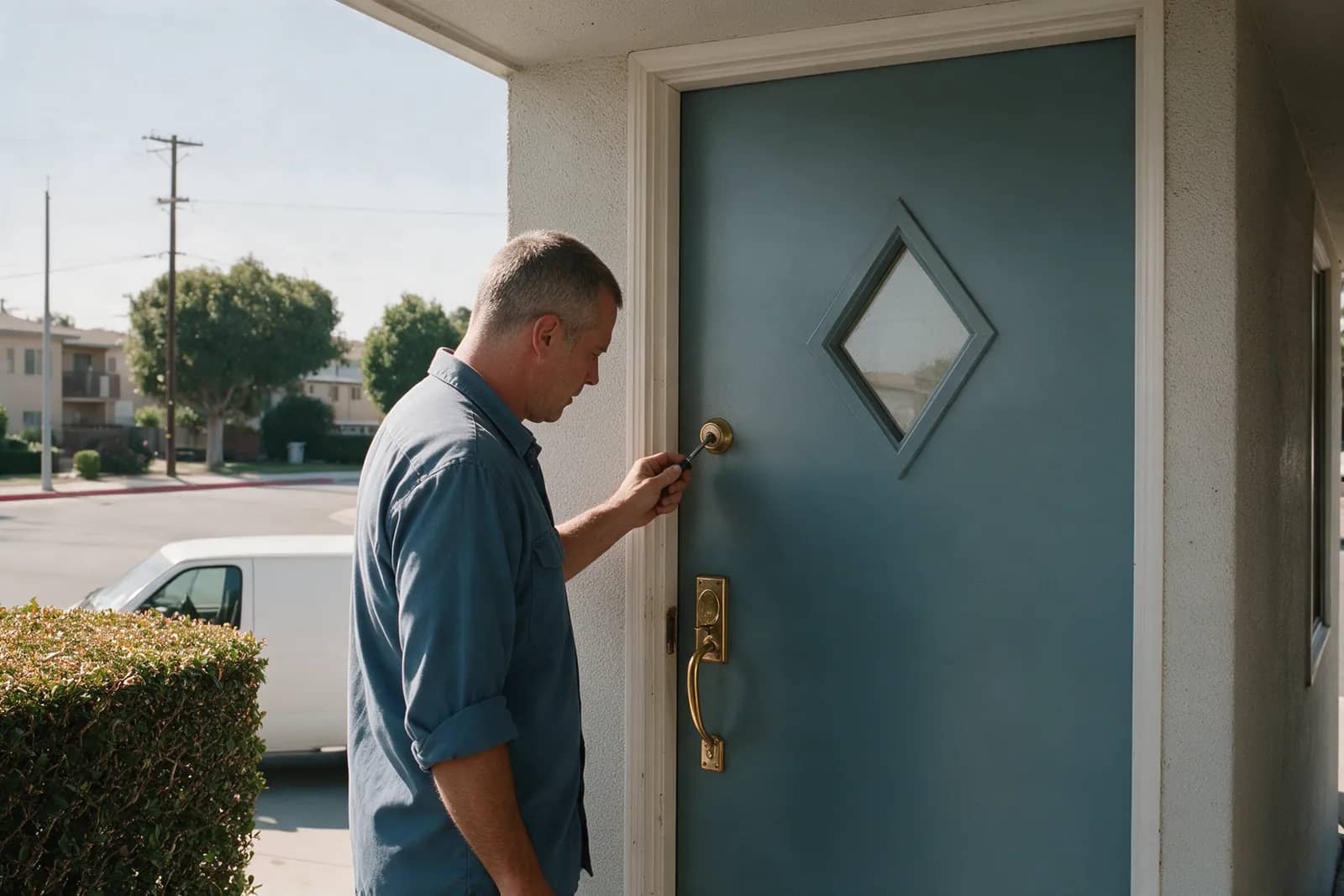
What was hung on these doors when the orchards went
Cherry Chase and the bird streets went up in the middle fifties on land that had been growing fruit the season before. The houses are long and low, one story, wide eaves, a front door under a shallow porch and a side door onto a carport or a utility room. The doors themselves are usually solid slabs of fir with real stiles and rails, hung in frames cut from timber that a builder today would not be able to buy.
The hardware that went on them was chosen the way everything on those sites was chosen, by the pallet, and that turns out to have been lucky. Mid-century residential lock sets from the better makers were cast and machined rather than stamped and plated, with parts you can still take apart with a screwdriver on a kitchen table. Seventy years of hands, weather and paint later, a fair proportion of them are still doing their job, which is not something that will be said about most of what is sold in a blister pack this year.
The parts genuinely worth keeping
Three things on these houses are usually worth preserving. The knob set itself, where it is one of the heavier cast designs: the roses are wide, the spindle is solid, and the cylinder inside can nearly always be taken down and repinned to a new key rather than thrown away. The hinges, which on these frames are commonly solid butts with removable pins, still square and still carrying a door that has swung ten thousand times. And the frame and slab, because a fir slab with tight grain is stiffer than the engineered doors that replace it, and it holds a fastener.
Maintenance on old hardware is mostly restraint. A cylinder that has gone stiff wants a dry lubricant — graphite or a PTFE spray — not a household oil, because oil holds the dust that comes in off a dry summer street and turns into a paste inside the plug within a year. A latch that drags usually wants the strike adjusted, not the lock replaced. And paint is the quiet killer on these doors: forty years of coats on the edge of a slab and around a rose adds enough thickness to bind a latch and to make a knob feel worn out when it is not. Stripping the edge is often the whole repair.
When a long-owned house changes hands
A great many of these houses have had one or two owners in their lives, and when they sell, the keys that exist are genuinely unknown. A gardener from a decade ago, a neighbor who watched the place during a hospital stay, an adult child two states away, the contractor who did the bathroom in 2008. The point of a rekey on such a house is not that anyone is expected to turn up. It is that the answer to the question of who holds a key changes from nobody knows to one name.
The good news for anyone who likes the way these doors look is that the original hardware usually stays on them. Repinning is done to the cylinder that is already in the knob, so the finish, the rose and the patina on the escutcheon are untouched and only the key changes. Rekeying is $28 to $45 per cylinder, and the doors are counted while you are on the call so one figure comes back for the house rather than a running total on the day. Front knob, back door, the carport or utility door, a shed at the end of the yard: four is a common count on these streets.
The one thing on these doors always worth replacing
If only one change is made to a fifties front door, make it the second lock. What these houses were given as standard was a keyed knob and nothing more, and the security of the opening rests entirely on a spring latch with a short angled bolt. Where a second lock was added later it is often a surface-mounted night latch screwed to the inside face, or a small auxiliary bolt in the knob housing itself, and both of those throw a short distance into thin material.
The replacement is unglamorous and it is the best value on the whole house: a single-cylinder deadbolt with a bolt that throws a full inch, bored properly into the slab above the knob and keyed to match the rest of the doors. A solid fir slab takes one well, which is not true of every door built since. Two practical notes. Choose the thumbturn on the inside, not a key cylinder, because a door people leave through in a hurry should never need a key from within. And where the same house has a hollow-core slab hung on a side or utility door — several of these tracts did exactly that — a better lock will not make that door stronger, and the honest recommendation there is the door itself.
Side gates, carports and the utility room door
On the bird streets the way in that people forget is not the front. It is the side gate, the carport and the door from the carport or the utility room into the kitchen. That door is frequently the oldest and lightest lock on the property, on the least visible face of the house, and it opens straight into the room where the keys and the bags live. If anything on a fifties house deserves an evening of attention after the front door, it is that one.
The screen door deserves a word too, since almost every one of these houses has an aluminum screen or security door in front of the main slab. Their little latches and hook locks were made to hold a door against a breeze and a cat, and they are worth keeping in working order for exactly that reason, but nothing about a screen door latch belongs in the security of the opening. Fix it because a screen door that bangs all night is a nuisance. Do not count it. The lock that matters is the one in the slab behind it.
The figures on a house like this
Rekeying original cylinders is $28 to $45 each, counted on the call so one figure covers the property with the $89 visit already inside it. Fitting the deadbolt described above, or replacing hardware that has finally worn past repair, is lock replacement and installation at $125 to $315 per door. A keypad on the front door for a household that is tired of the hide-a-key is smart lock installation at $189 to $469. Being shut out of the house, which on these streets most often means a back door that swung closed behind somebody in the yard, is $125 to $219, and the door gets opened intact.
Whichever Door Stops You is how Baylands Lock & Access prices and behaves. The figure is said on the call and it already holds the visit, the labor and the parts. The receipt carries that figure whatever is discovered once seventy years of paint comes off a rose. The lock is opened without harm first, and a drill comes out only after you have said so, and never to reach a bigger number, which matters more than usual on original hardware that cannot be bought again. Card or tap at the door, an itemized receipt by email, and a written line for a landlord, a building manager or an HOA when one is needed. Calls are answered 24/7, with $50 already inside the figure between 8pm and midnight and $85 between midnight and 7am.
Quick answers
Are the original knobs on my 1955 house worth keeping?+
Usually yes. The better mid-century sets were cast and machined, the parts come apart with a screwdriver, and the cylinder can nearly always be repinned to a new key. Most of what feels worn out on them is paint on the door edge and dust in the plug, not a failed lock.
We just bought in Cherry Chase. Rekey or replace?+
Rekey, in most cases. Repinning happens inside the cylinder already in the door, so the original finish stays exactly as it is and only the key changes, at $28 to $45 per cylinder with the doors counted on the call. Keep replacement for hardware that has actually worn out, and for the deadbolt these doors never came with.
What is the single upgrade you would make on a fifties front door?+
A deadbolt with a full one-inch throw, bored into the slab above the knob, with a thumbturn on the inside rather than a key. These houses came with a keyed knob and a short spring latch, and that one addition does more than any other change on the door. It is $125 to $315 fitted, with the visit inside the figure.
Need it handled rather than read about?
(669) 202-7014More guides