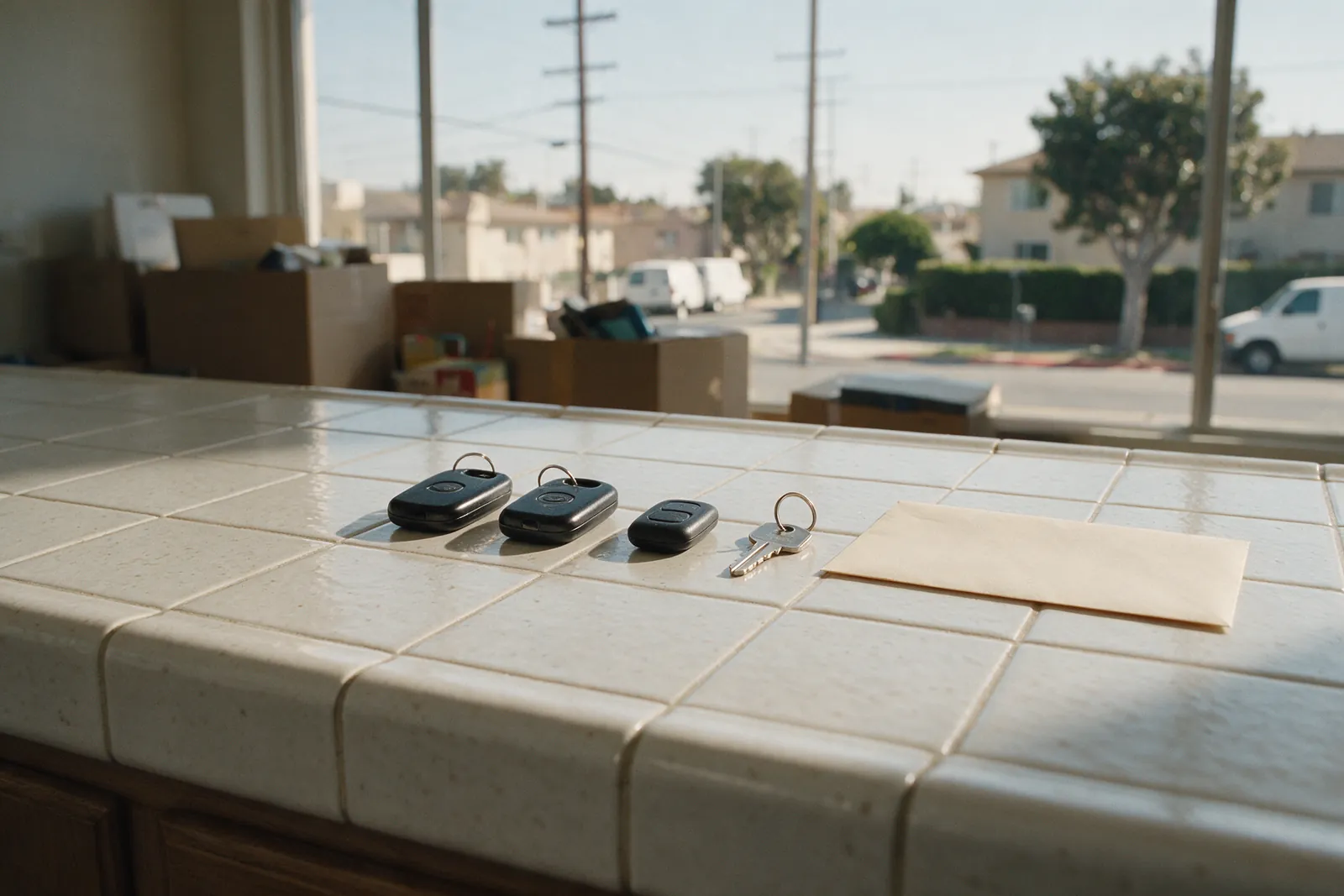
The list nobody hands you on the way in
Move-in day is a stack of paperwork and a handful of hardware, and the hardware is rarely itemized anywhere. Two years later, on a Saturday with a truck outside, it has to be reassembled from memory. On a typical four- or five-story block here the full set is longer than people remember: unit door key, sometimes two, a fob for the lobby, a second fob because the household has two adults, a mailbox key, a remote for the vehicle gate, a clicker or a fob for the garage, a code for the parcel room, a padlock or a key for the storage cage, and often a separate fob for the gym or the roof deck.
Write the list before the truck arrives, not while it is idling. The items that go missing are always the same ones: the second fob that lived in a coat pocket, the spare gate remote in the car that got sold, and the storage cage key from a cage nobody has opened in a year. Every one of those is a line item on a deposit statement, and the amounts are set by the building rather than by us.
Handed back is not the same as switched off
This is the part worth understanding, because it is where the assumptions go wrong in both directions. Returning a fob to the office is a physical act. Removing that fob from the building's credential list is a separate administrative act, done in the software by whoever holds the account. The two normally happen together. Sometimes they do not, and a fob sitting in a drawer in the leasing office is still a live credential until the number is cleared.
For a departing tenant this matters for a plain reason: if a credential you signed for is still active and something happens on the property, the record still points at your name. So ask for one line in writing at handover, saying the fobs and remotes returned have been de-enrolled, with the date. A manager can produce that in a minute. For a manager, the same line is the whole point of a move-out sweep, and after a visit here that de-enrollment is described plainly enough to go straight into a unit file.
Codes are the awkward item
Fobs and remotes can be individually killed. Codes usually cannot. The parcel room keypad, the gate keypad and the amenity room code are, in most buildings on this side of the city, one shared number that every resident knows. Nothing happens to it when one household leaves, because changing it would strand everyone else until the notice went out. That is a design decision made years ago in most of these buildings, and it is why newer systems issue a per-resident code or drop keypads in favor of fobs.
There are two honest responses to that as a tenant. Stop using the code, and do not pass it on to the next person who asks — the incoming resident gets it from the office, not from you. And if you are the manager reading this, a shared parcel code that has not changed in three years is the single cheapest thing on the property to improve, either by rotating it on a schedule or by moving that door onto the fob system. Both sit inside ordinary access control work rather than being a project.
The mailbox key, and who owns that lock
Mail is the item that catches people out, because two different arrangements exist on the same street. Where a building has a gang of boxes in the lobby that belongs to the property, the lock is the building's, the key is handed to the office, and a lost one is replaced by the building at whatever they charge for it. Where mail arrives in a cluster unit at the curb serving several addresses, that lock belongs to the postal service, and neither the manager nor a locksmith replaces it: the request goes through the post office and the key is issued by them.
Ask which one you have before move-out week rather than during it, because the postal route takes longer than a walk to the leasing office. And redirect the mail regardless. A returned mailbox key with no forwarding order in place is how a departing tenant finds out three weeks later that a card was reissued to an address they no longer hold.
The clicker, the garage and the space you no longer have
Garage credentials get their own paragraph because they are the ones most often kept by accident. A vehicle gate remote clipped to a visor leaves with the car. A garage clicker paired to the building receiver keeps working until someone clears it, and on older fixed-code receivers there is nothing individual to clear at all — the remote sends the same code as every other remote in the building, so the only way to retire one is to change the code and re-issue the lot. That is a building decision and a building cost, and it is the reason many complexes have moved the garage onto fobs.
Practical move-out sequence for the garage: return the clicker, confirm the space number is released, and check the car for a second remote and for a built-in visor button that was paired to the receiver at some point and forgotten. A car's built-in button is a credential like any other. If it was paired, say so at handover, because it does not leave the building's memory when the car drives away.
Timing, authority and the figures
Move-outs here run late. Leases end at noon and trucks finish at two in the morning, and that is ordinary rather than exceptional in a city that works shifts. Calls are answered 24/7, and the overnight amount is already inside the figure rather than appearing at the door. Authority stays where it always is: a tenant orders work on their own unit door and their own fob; the credential list, the parcel room, the gate and the garage receiver are shared and need the building manager or the HOA to order the work.
The numbers. Access control is $149 to $429, and that band takes in de-enrollment work, replacement fobs and remotes, clicker pairing and clearing, keypad code changes and reader faults. A unit lockout on move-out day, when the keys went into a box that is already on the truck, is $125 to $219. Damaged unit hardware found at the walkthrough is lock replacement and installation at $125 to $315. Whichever Door Stops You covers all of it: the figure is said on the call and holds the visit, the labor and the parts; the receipt repeats that figure whatever the technician finds; nothing is drilled where it can be opened intact, and a drill only after you say so, never at a higher price; card or tap on site, an itemized receipt by email, and a written line for a manager or an HOA when the file needs one. Between 8pm and midnight $50 is inside the figure and between midnight and 7am $85 is.
Quick answers
I lost a lobby fob before moving out. What happens?+
Tell the office in writing so the number can be de-enrolled, which is the part that actually matters. The building will charge its own replacement fee from your deposit. The de-enrollment and a replacement fob are access control work at $149 to $429, ordered by the manager or the HOA because the credential list is theirs.
Can I arrange the de-enrollment myself so it is definitely done?+
No. The credential list belongs to the building and only the manager or the HOA can authorize changes to it. What you can do is ask for a dated written line confirming the fobs and remotes you returned have been cleared, which takes a manager a minute and settles the question.
Nobody will change the parcel room code when I leave. Is that normal?+
Yes, in most buildings here that code is shared by every resident, so it does not change for one household. Stop using it and do not pass it on. If you manage the property, rotating that code on a schedule or moving the door onto the fob system is ordinary access control work rather than a project.
Need it handled rather than read about?
(669) 202-7014More guides