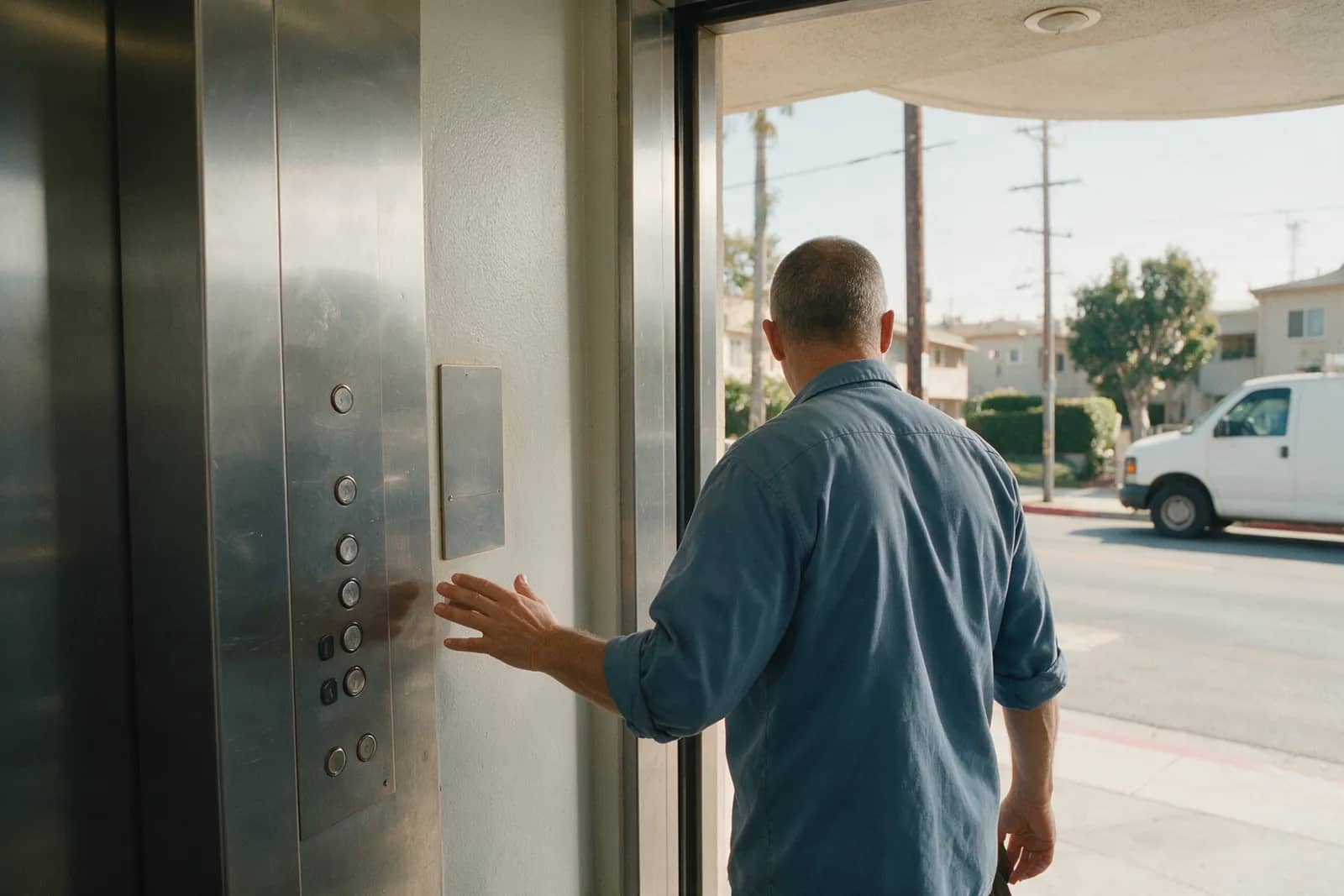
In the newer towers the elevator is a door
The buildings that went up on the north edge of the city do not really have a front door in the old sense. You turn off Java Drive or Caribbean Drive, the garage gate lifts, you park two levels down, you cross to a lobby vestibule and you tap a fob inside the elevator cab before your floor button will light. Four controlled openings before a key touches anything, and the unit door at the end of it is often the only conventional lock in the sequence.
That sequence is worth understanding because it changes what a failure means. When somebody says they are locked out of a tower, they may be standing at a garage gate on a wet night, or in a lobby that let them in but will not let them up, or at their own door on the eleventh floor. Those are three different jobs with three different answers, and naming which one it is on the call is the difference between a technician arriving with the right parts and arriving with a question.
How floor restriction actually works
There is a reader in the cab, usually on the panel beside the buttons. It does not talk to the buttons directly. It reads a credential and passes the number to the access system, which checks which floors that credential is allowed and then enables those buttons through a relay board wired into the elevator controller. In some newer installations the choice happens in the lobby instead: you present a fob at a panel, it assigns you a car, and the cab takes you where your credential says you may go without you pressing anything.
Two consequences follow. First, a fob can be perfectly valid and still not light your button, because the floor rights attached to it are a separate field from the door rights. That is the commonest complaint in these towers by a wide margin. Second, the boundary of responsibility runs right down the middle of that cab. The reader, the credential, the floor rights and the access system are one world. The elevator controller, the relay interface in the machine room and the traveling cable that feeds the cab belong to the elevator company under the building's maintenance contract, and no locksmith should be opening that.
What gets sorted on site, and what does not
On site: a cab reader that has gone dead or intermittent, a reader loose in its faceplate, a credential that reads and is refused, floor rights that need adding or removing once management authorizes it, a fob replaced and enrolled, a lobby panel that is not reading, and the common case of a resident who moved from the sixth floor to the ninth and whose credential still carries the old floor. Also the ordinary lobby and vestibule hardware around the elevator: strikes, magnets, sensors and closers.
Not on site, and said plainly on the call rather than in the lobby: anything inside the elevator controller, the relay board interface where it is installed in the machine room, the traveling cable, the cab operating panel behind its faceplate, and any fault where the buttons behave oddly with no credential involved at all. If the elevator does something strange when nobody has tapped anything, it is an elevator call. Knowing that split before dispatch is why a manager gets a useful answer at nine at night instead of two trades pointing at each other.
Garage clickers: paired, learned, and cleared
The garage door or gate has a receiver with a learn button. Press it, press the remote, and that remote is written into memory. Simple, and it hides two traps. The memory has a limit — a few dozen remotes on a small receiver — and a building that has issued clickers for years eventually fills it, at which point new remotes will not take until old ones are cleared. Clearing is usually all or nothing: press and hold, the memory wipes, and now every remote in the building has to be re-learned. That is a scheduled evening with notice on the doors, not a five-minute call.
Rolling-code receivers are the other half of the story. The remote and receiver advance a code together, and a remote pressed a few hundred times outside range can fall out of the window and simply stop working while looking perfectly healthy. Re-pairing brings it back. Universal remotes and the buttons built into a car's rear-view mirror can be trained to most of these systems, sometimes needing a working handheld remote present to complete the pairing. A car with a built-in button that was paired years ago is a live credential in the building's receiver, and it stays live when the car is sold unless somebody clears it.
What a resident may arrange, and what the building holds
The split in a tower is the same as anywhere else here, and it is worth stating because the hardware is unfamiliar. Your own unit door is yours. Your own fob is yours to have replaced. Your own remote is yours where the building allows residents to hold one, including pairing it to the receiver. Everything else in the sequence you walk through every day is shared: the garage gate and its receiver memory, the vestibule and lobby readers, the cab reader, the floor rights on any credential, the parcel room, the amenity floor.
Floor rights are the one that surprises people most. It feels like a setting on your own fob, and technically it is, but it is a permission the building grants inside its own system, so the manager or the HOA authorizes the change. A resident who has moved units, taken a second parking space or added a household member asks management, and management asks for the work. A written request naming the unit, the floor and the credential number is the version that gets done the same week.
Hours, cars in the structure, and the figures
These buildings run on shifts, and so do their failures. A red-eye arrival at two in the morning who cannot get past the vestibule is an ordinary call here, not an emergency exception, and the overnight amount is already inside the figure rather than being added when the van arrives. Calls are answered 24/7. The van is based in Moffett Park, so the towers along Java Drive and Caribbean Drive are about fifteen minutes, at the near end of the fourteen to thirty-one minutes that covers Sunnyvale and averages twenty-one.
Access control is $149 to $429, taking in cab and lobby readers, credential and floor-right work, fob enrollment, garage receivers, clicker pairing and memory clearing, keypads and call boxes, with the $89 visit already inside that band. A resident shut out of their own unit door upstairs is $125 to $219. A car locked with the keys inside on level two of the structure, or at the Caltrain lot, or in an office garage off Mathilda, is a car lockout at $105 to $199, and a car fob that needs programming is $89 to $195 — a different item entirely from the building fob in your pocket. Whichever Door Stops You holds throughout: the figure is said on the call and contains the visit, the labor and the parts; the receipt shows that same figure whatever is found behind the panel; openings are made without damage first and a drill only once you agree, never to reach a higher number; card or tap on site, an itemized receipt by email, and a written line for a manager or an HOA. Between 8pm and midnight $50 sits inside the figure, and between midnight and 7am it is $85.
Quick answers
My fob opens the lobby but the elevator will not take me to my floor. What is wrong?+
Almost always the floor rights attached to your credential, which are stored separately from the door rights. The fob is valid, the reader is reading it, and the system is simply not enabling that button. The manager or the HOA authorizes the change, and it is access control work at $149 to $429.
Can the garage button built into my car be paired to the building receiver?+
Usually yes, on both fixed-code and rolling-code systems, and on some rolling-code receivers a working handheld remote has to be present to finish the pairing. Remember that a paired car button is a live credential, so tell the office when you sell the car or move out so it can be cleared.
Should I call a locksmith or the elevator company?+
If the problem involves a credential — a fob refused, a floor not enabled, a dead reader in the cab — it is access control work. If the elevator misbehaves with no fob involved, or the fault is inside the controller, the machine room or the cab operating panel, it belongs to the elevator contractor under the building's maintenance contract. Say what the reader does when you tap, and the split is clear on the call.
Need it handled rather than read about?
(669) 202-7014More guides