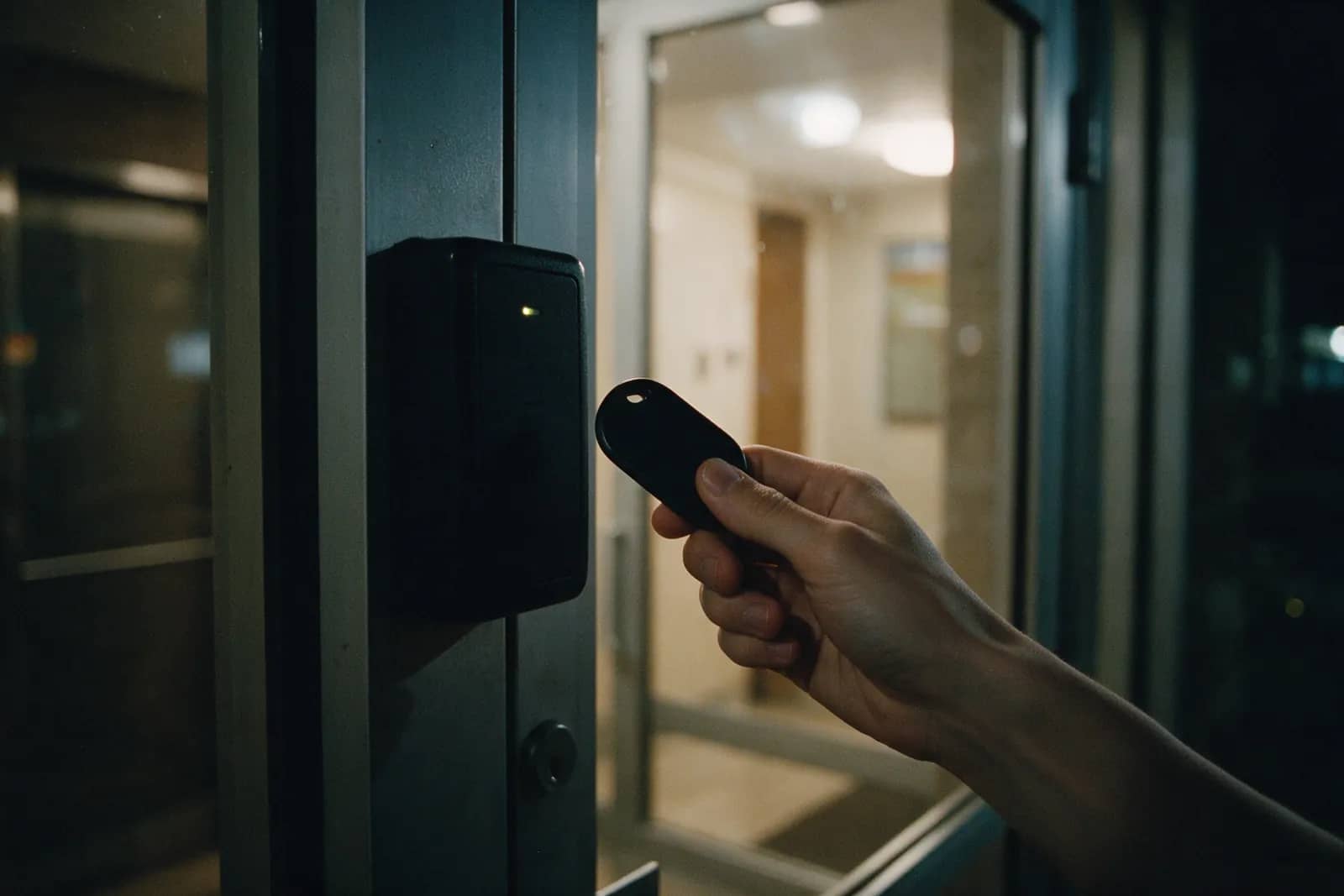
The same complaint, four different faults
It is nine at night on Fair Oaks Avenue, the fob that worked this morning does nothing at the lobby, and there is no keyway in that door to fall back on. What has failed is one of four things, and they are not equally serious. The fob itself. The reader on the wall. The controller and its power supply, usually in a locked electrical closet. Or the record of your credential inside the building's software, which someone removed or which was never carried across when the management company changed.
Only one of those is a lock in any ordinary sense. That is worth saying at the start, because a lobby reader that has stopped granting access is not a lock to be picked, and the fix is almost never at the door face. It is also why the checks below matter. Two or three minutes standing at the wall narrows four causes to one, and the figure said on the call is a better figure when the fault is already named.
Start with the fob, and the other doors on the same system
Most building fobs on the blocks off Wolfe Road and around Moffett Park are passive. There is no battery inside them. The reader throws out a small field, the fob draws power from it and answers with a number. That is the whole transaction. So a fob that has gone quiet has usually not gone flat, and a fob that has been through the wash more often survives than not. The ones that do carry a battery are the larger Bluetooth remotes and the gate clickers, and those announce themselves by getting weaker over weeks rather than dying between the morning and the evening.
The test that separates fob from door costs nothing. Take the same fob to another opening on the same system: the garage man-door, the parcel room, the side gate, the mail alcove. If it works at one of those and not at the lobby, the fob is fine and the lobby door is the problem. If it works nowhere, the fob or your record is the problem. Then borrow the second half of the test from a neighbor: if their fob opens the lobby and yours does not, the door is fine and the fault sits with your credential.
What the reader is telling you with its light and its beep
Readers talk, quietly. A standing red or amber light usually means the reader is powered and idle, and it is normal. A short beep with a green flash means the credential was read and accepted, so if the door still does not open, the fault is downstream at the strike or the magnet, not at the reader. A beep followed by a red flash means the credential was read and refused, which is the single most useful signal there is: the hardware works and the list does not have you on it. Silence with no light at all means the reader has no power, and that is a wiring or a supply fault.
There are also honest false alarms. A fob buried in a wallet behind three transit cards and a hotel key can be shielded or confused by the other cards, so present it alone. A steel keyring pressed flat against the reader detunes it. Some readers have a sweet spot an inch off center rather than at the middle of the plate. And an exterior reader on a wall that takes weather, which describes plenty of them on the north side of the city, reads shorter when it is wet. Hold the fob still against the plate for two full seconds instead of waving it.
The controller, and why the whole building fails at once
Behind the readers there is a controller board and a power supply, normally in a service closet with a battery beside it. The readers do not decide anything. They read a number and pass it to the controller, and the controller checks the list, checks the schedule, and closes a relay that releases the door. That structure explains the pattern people notice: when one resident cannot get in, it is a credential; when nobody can get in, or when every door on one side of the building goes dead together, it is the controller, its supply or the circuit feeding them.
Two controller faults are common enough to name. After a power cut the backup battery carries the system for a while and then gives out, and the doors do whatever they were designed to do when power is lost — some fall unlocked, some stay locked. And schedules stick. A lobby set to unlock for daytime deliveries and relock in the evening can hold in the wrong state after a clock resets, which is why a door can be found standing free at midnight or refusing every fob at ten in the morning. None of that is a resident's to touch. It is reported to the manager, and the manager authorizes the visit.
De-enrollment: the cause nobody thinks of
The quietest cause is administrative. Your credential number was deleted, expired or never migrated. This happens more than people expect: a lease renewal processed as a new record, a building changing management companies and rebuilding the list from a spreadsheet, a batch of numbers cleared after a set of fobs was reported lost, or an expiry date typed into a field when the fob was first issued and forgotten by everyone since. The fob is intact. It is simply not on the list any more.
The tell is the one described above: the reader beeps and shows red. Read and refused. When that is what is happening, no amount of work at the door helps, and a resident who reports it that precisely saves everyone a wasted evening. Say to the manager that the reader reads the fob and denies it, and that the same fob is denied at the garage door too. That sentence points straight at the credential record, which is a change made in the building's software by whoever holds the account for it.
Who can order the work, and the figures
The line is clean and it is worth knowing before dialing. Your own unit door and your own fob are yours to arrange. The lobby reader, the controller, the shared gate and the parcel room belong to the building, and work on them is ordered by the building manager or the HOA. A resident locked out of the block at midnight can be let into their own unit door once they can show they live there; a resident cannot commission a change to the lobby reader on their own account. Some buildings put a standing authorization in writing so a resident can order a replacement fob directly, and if yours has, say so on the call.
Access control work is $149 to $429 here, which is a price rather than a promise to quote later. That band covers reader diagnosis and replacement, fob stock and enrollment, strike and magnet faults, controller and power supply work, keypads and call boxes. A lockout at your own unit door is $125 to $219. Arrival runs fourteen to thirty-one minutes across Sunnyvale, twenty-one on average, and seventeen to the apartment blocks around Fair Oaks and Wolfe. Baylands Lock & Access works to Whichever Door Stops You: the figure is said on the call and already contains the visit, the labor and the parts, whether the answer turns out to be a cylinder, a reader or a board; the receipt shows that same figure whatever is found once the cover comes off; the opening is made without damage first and a drill only once you have agreed to it, never to reach a higher number; card or tap at the door, an itemized receipt by email, and a written line for a landlord, a building manager or an HOA when one is wanted. Calls are answered 24/7, with $50 already sitting inside the figure between 8pm and midnight and $85 between midnight and 7am.
Quick answers
My fob opens the garage door but not the lobby. What does that mean?+
It means the fob and your credential are both fine, because the same number was accepted somewhere else on the same system. The fault is at that one opening: the reader, its wiring, the strike or magnet, or a schedule set on that door. It is a shared opening, so the manager or the HOA orders the work.
Does a building fob have a battery I can change?+
Usually not. Most lobby and gate fobs are passive and take their power from the reader field, so there is nothing inside to replace. Battery-powered credentials are the larger Bluetooth remotes and some gate clickers, and those fade over weeks rather than failing overnight.
Can I just buy a replacement fob online and have it programmed?+
The blank can often be enrolled, but the enrollment is a change to the building's credential list, so the manager or the HOA has to authorize it. Fob work on a shared system sits in access control at $149 to $429 with the $89 visit already inside the figure. A car key fob is a different job entirely and is priced separately.
Need it handled rather than read about?
(669) 202-7014More guides