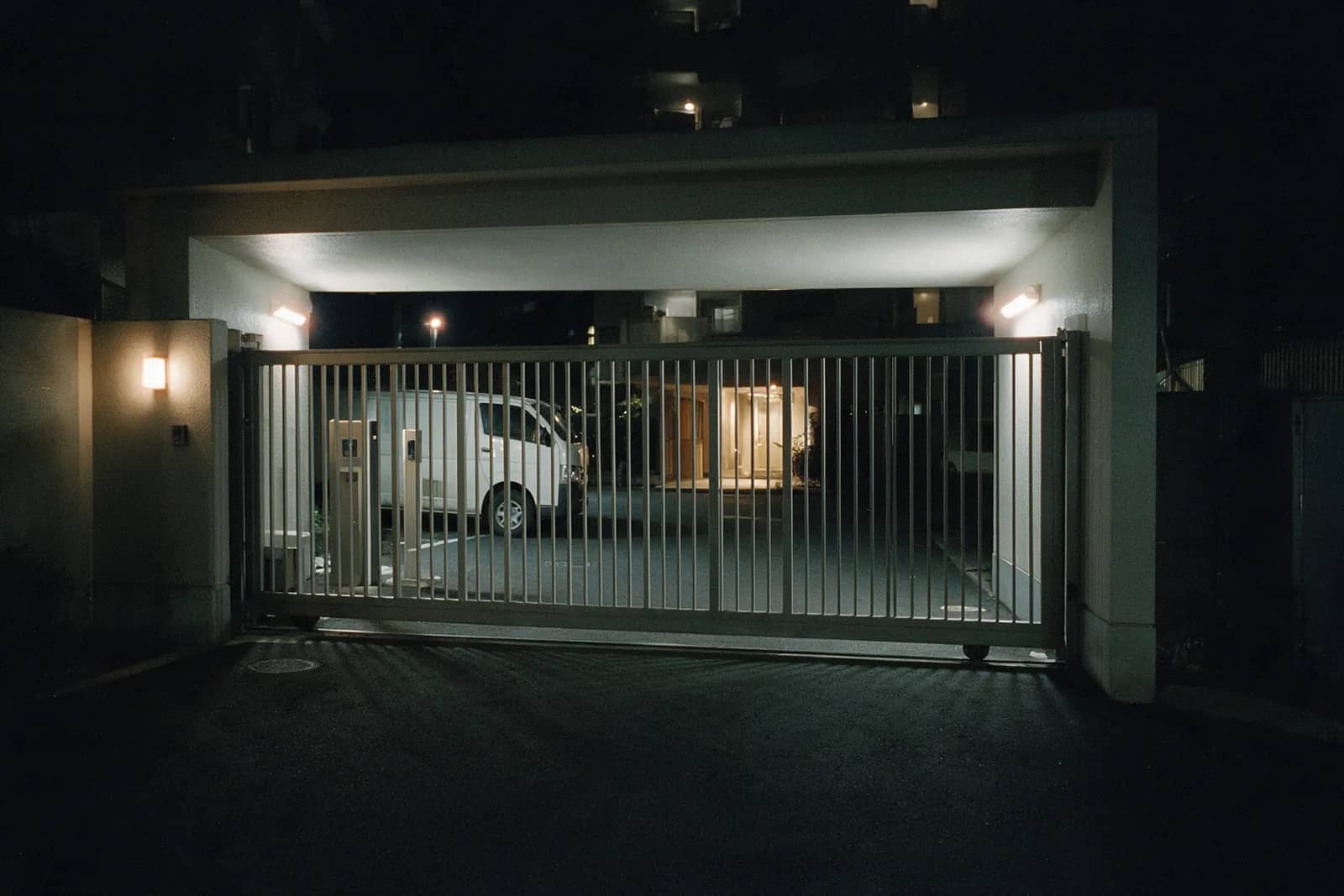
The gate is the first door and the least looked after
Most apartment blocks and townhome complexes here have two gates rather than one: a vehicle gate that slides or swings across the driveway, and a narrower pedestrian gate beside it for people arriving on foot. They are almost never on the same hardware. The vehicle gate has an operator, a motor in a steel cabinet with a control board inside, and it answers to remotes, a keypad, a call box and a loop buried under the asphalt. The pedestrian gate usually has a reader and an electric strike or a magnet, and behaves like a lobby door.
The gate also takes more punishment than anything else on the property. It runs outdoors, it cycles a few hundred times a day at a busy complex, it lives in weather, and nobody notices it until it stops. Then it stops at the worst possible moment, which for a gate is a wet evening with three cars queued behind you on Wolfe Road and nowhere to turn around.
Three ways in, and each one breaks differently
A remote, sometimes called a clicker, sends a radio code to a receiver on the operator. Older receivers take a fixed code set by little switches, and every remote in the complex sends the same one. Newer ones use a rolling code, where the remote and the receiver step through a sequence together, and a remote that has been pressed hundreds of times out of range can fall out of step and need re-pairing. A keypad sends a code down a wire, and its faults are worn keys, water behind the faceplate, and a code that management changed without telling half the building.
A call box is the third route, and it is not for residents at all. It is for visitors. It holds a directory of names and codes, each one tied to a telephone number, and when a delivery driver keys the code it places a call to that number. Whoever answers presses a digit and the gate opens. There is no key anywhere in that chain. So the commonest gate complaint on this side of the city — the call box will not reach me — is not a lock fault, it is a phone number in a directory that nobody updated when the unit changed hands.
Why gates fail in the rain
Winter calls cluster for reasons that are mechanical rather than mysterious. Water gets into the operator cabinet through a lid gasket that hardened years ago, and condensation forms on the board every cold night whether rain falls or not. Conduit that runs underground fills with water, and the wet finds its way up into a terminal strip where the corrosion is green before anyone opens the lid. The buried loop that senses a car and lets the gate open from the inside is a coil of wire in a saw cut sealed with mastic, and once that sealant fails the loop reads erratically. Cars sit in front of an open gate that will not close, or wait at a gate that never notices them.
The photo eyes are the other winter regular, and they are usually behaving correctly. A pair of eyes across the driveway stops the gate closing on a car or a person. Fogged lenses, a spider web across the beam, a post nudged by a bumper, or low winter sun straight into the receiver all read as an obstruction, and a well-designed gate responds by refusing to close or by reversing. That is the safety working, not failing, and the repair is alignment and cleaning rather than defeating the sensor. Anyone who suggests disconnecting the eyes to make a gate behave is proposing something that should not be done on a driveway people walk through.
The call box, the phone line and the directory
Older call boxes were wired to a copper telephone line, and as those lines have gone away buildings have moved to cellular units that carry their own service. Both hold the same thing: a list of directory codes against phone numbers. Two facts about that list save a lot of confusion. First, the directory code is very often not the unit number, and in many buildings it deliberately is not, so that a visitor cannot work out where somebody lives from the panel. Second, the number on file is only as current as the last time someone updated it, and residents change phone numbers far more often than management updates directories.
A resident can ask for their own entry to be corrected, and should, in writing, naming the unit and the number. A resident cannot reprogram the box. It serves every unit in the complex, so the account and the authority for it sit with the manager or the association board. The same goes for adding an entry for a new occupant, hiding a name from the display, or changing the digit that releases the gate during a call.
What you can arrange alone, and what needs the association
Here is the split as it actually works. Your own unit door, your own fob and, in most complexes, your own remote are yours to arrange, including pairing a replacement remote to the receiver where the building lets residents hold one. Everything that serves more than your household needs the manager or the HOA to order it: the gate operator and its board, the keypad and its codes, the call box directory, the buried loop, the photo eyes, the pedestrian gate reader.
That is not bureaucracy for its own sake. A gate code changed because one resident asked would lock out everyone who was not told, and a remote paired into a receiver without the building knowing is a credential nobody has a record of. If a code needs changing because someone who no longer lives there still has it, the useful move is a written request to management naming the reason. Managers act on records. A remark in the parking lot goes nowhere, and the resident who put it in writing is the one whose request gets scheduled.
Where our work ends, and the figures
One honest limit, said up front rather than discovered on site. The access side of a gate is our work: remotes and pairing, receivers, keypads, call boxes and their directories, readers, strikes and magnets on the pedestrian gate, and the wiring between those parts. The mechanical side of a heavy vehicle gate — a burned-out motor, a stripped gearbox, a broken chain, a slide gate off its rollers or a bent frame after a bumper found it — is a gate contractor's job, and saying so on the call is more useful than turning up and saying it in the driveway.
Gate access work sits in access control at $149 to $429, which covers remotes and re-pairing, keypad programming and replacement, call box directory work, reader and release faults on the pedestrian gate. That band has the $89 visit inside it already. The van is based in Moffett Park and arrival runs fourteen to thirty-one minutes across the city, twenty-one on average, with the Lakewood and Baylands edge streets around nineteen. Whichever Door Stops You is how the money behaves: one figure named on the call, holding the visit, the work and any parts; the same figure printed on the receipt whatever the cabinet turns out to contain; nothing forced open where it can be opened intact, and a drill only with your agreement and never for a higher number; card or tap on site, an itemized receipt by email, and a written line for a manager or an HOA when the board needs one for a file. Calls are answered 24/7. Between 8pm and midnight $50 is already inside the figure, and between midnight and 7am $85 is, so a wet Tuesday at one in the morning lands high in its band instead of above it.
Quick answers
The gate stands open all night and will not close. Is that a security problem or a broken gate?+
Usually neither, in the sense people fear. A gate that refuses to close is normally obeying its safety sensors: fogged or misaligned photo eyes, a web across the beam, or a wet loop reading a car that is not there. The fix is cleaning and alignment. It is a shared opening, so the manager or the HOA arranges it.
My remote stopped working but the keypad still opens the gate. Why?+
The remote and the keypad reach the operator by different routes, so one can fail alone. On a rolling-code system a remote pressed repeatedly out of range can fall out of step and need re-pairing. On a fixed-code system a changed setting in the receiver leaves old remotes dead. Both sit in access control at $149 to $429.
A former roommate still knows the gate code. Can I have it changed?+
Not on your own account, because that code serves every household in the complex. Put the request in writing to the manager or the board, naming the reason. Your own unit door and your own fob are a different matter and you can arrange those yourself.
Need it handled rather than read about?
(669) 202-7014More guides