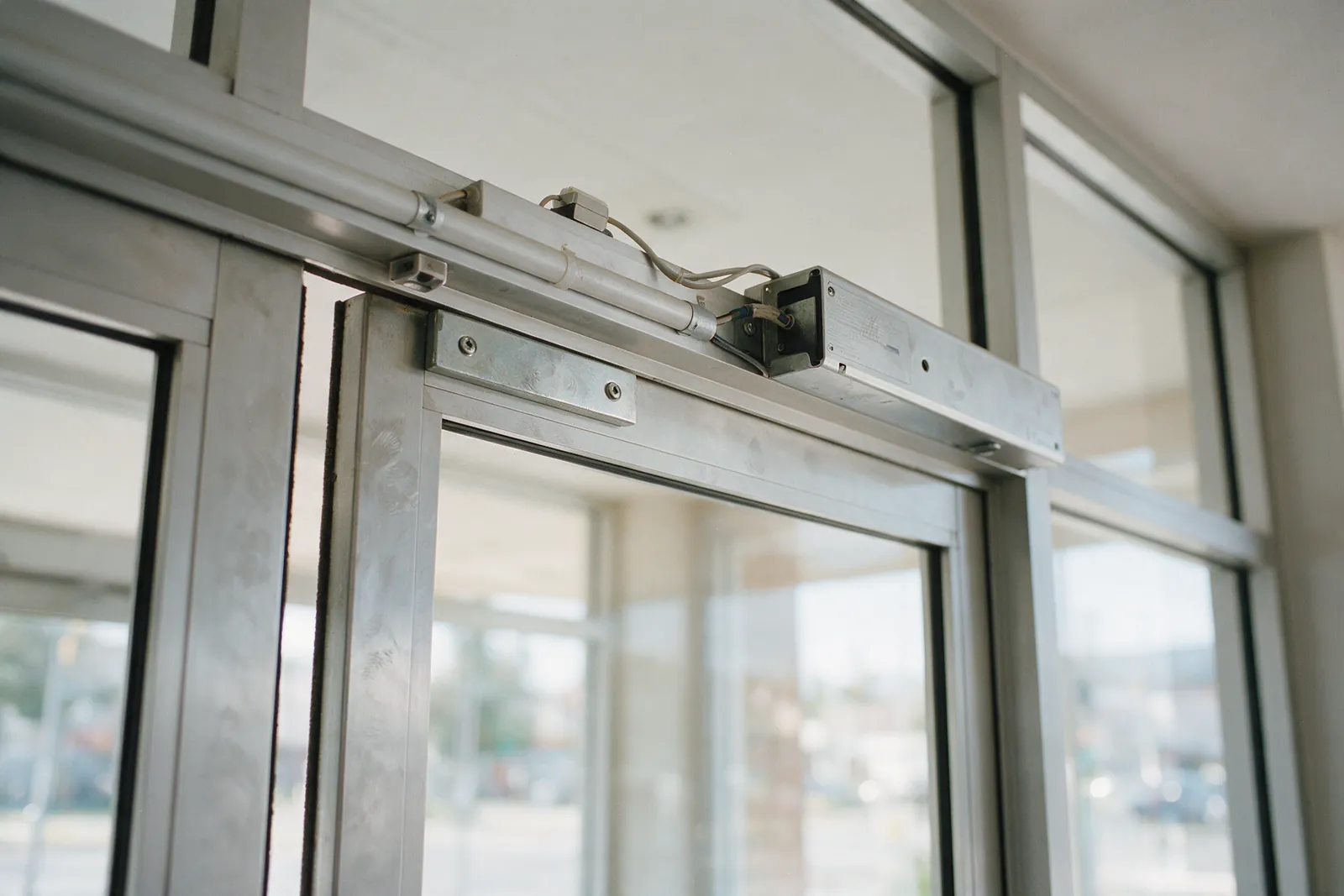
Three parts that get called the same thing
Residents and staff usually describe all of it as the lock. On a controlled opening there are at least three separate devices. A magnetic lock is an electromagnet mounted on the frame with a steel armature plate on the door, and while it is energized the two hold together with several hundred pounds of pull. There is no bolt and no latch. Cut the power and the door swings free.
An electric strike is the other approach. It replaces the keeper in the frame, and the latch of an ordinary lock still does the work of holding the door. Energize the strike and the keeper releases, so the latch slides out and the door opens without the handle ever being turned from outside. The third part is the request-to-exit device, which is how the system knows someone inside wants to leave. It is either a motion sensor mounted above the door on the inside, a push button on the wall, or a switch built into the lever or the push bar itself.
Fail-safe and fail-secure, without the jargon
The two phrases sound similar and mean opposite things. Fail-safe means the device unlocks when power is lost. Fail-secure means it stays locked when power is lost. A magnetic lock is always fail-safe by its nature, because it is the current that makes it hold. An electric strike is made in both versions and the choice is made at purchase, not on site.
Which one belongs on which door is a building question. A lobby entrance on a maglock will release in a power cut, and people can leave and also walk in, which is why those doors usually have a mechanical lock behind the electric one for overnight. A stair door or a tenant suite door on a fail-secure strike stays locked when the power goes, and people can still leave, because on a fail-secure opening the inside lever always retracts the latch mechanically no matter what the electronics are doing. That last sentence is the whole principle: nobody should ever need power, a key or a code to get out.
How a controlled door is supposed to behave when you leave
Free egress means one motion. You walk up to the inside of the door, you push the bar or turn the lever or the sensor sees you, and the door opens. Not a code. Not a key. Not two separate actions, and not a knowledge of which button to press. On a maglock opening, that one motion has to actually drop the power to the magnet, which is why the request-to-exit sensor and the push button on the wall are not conveniences. They are the release.
That is also why maglock openings carry more parts than people expect: the sensor above the door, a push button within reach, a tie to the fire alarm so the magnet drops when the panel goes into alarm, and a supply with a battery so the rest of the system rides through a flicker. Remove any one of those and the door stops behaving properly in the exact circumstance where behaving properly matters. When something on a maglock door is disconnected because it was nuisance-tripping, this is the part that got disconnected, and it should be repaired instead.
What a fire inspector looks at on that opening
The inspection is not mysterious and it is largely about egress. Can a person leave in one motion, without special knowledge. Does the request-to-exit device work, and does the push button beside the door work. Does the magnet drop when the fire alarm panel goes into alarm, and is that connection real rather than a wire terminated at nothing. Is there a second manual latch, a slide bolt, a padlock or a chain that has been added to the inside of the opening, because that is the finding that closes buildings. Is the required signage present. Do the closers still shut and latch the door.
Two honest notes. Delayed egress arrangements, where a door signals and releases after a set number of seconds, exist and are permitted in specific circumstances with specific equipment and signage, and they are not something to improvise on a residential lobby. And the final say belongs to the fire official for the jurisdiction, working from the building's plans and its occupancy. Hardware gets installed to what the code official requires for that opening; anyone who tells you their opinion outranks the inspector's is selling something. Where a determination is needed, the right sequence is to ask the fire official first and fit afterwards.
What actually fails on these doors
The armature plate works loose. It is meant to be mounted with a little play so it can align itself against the magnet face, and once the through-bolt slackens the plate rattles, then sits crooked, then meets the magnet on one corner and holds with a fraction of its rated force. A door that can be pulled open with a firm tug while the light on the reader says locked is nearly always a plate problem, not a magnet problem. The other geometry fault is a door that has dropped on its hinges so the plate rides below the magnet face.
On strikes it is wear at the keeper and a closer that has weakened until the door rests against the frame without the latch snapping in. On sensors it is aim: a motion detector above a lobby door pointed too far into the room releases every time someone walks past the mailboxes, so the door effectively stands unlocked all evening. Add power supply batteries that have quietly reached the end of their life, and the propped door held with a wedge for a delivery at seven and still propped at ten, which no hardware anywhere solves.
Who orders it, and the figures
Every door described in this article is a shared opening, so the answer on authority is the same throughout: the building manager or the HOA orders the work, not an individual resident or an individual tenant business. A resident can and should report the fault precisely — which door, what the reader light does, whether the door opens from inside in one motion, whether it can be pulled open when it says locked. That report is what gets scheduled quickly.
Access control is $149 to $429 on this site, and that band covers magnets and armature plates, electric strikes, request-to-exit sensors and push buttons, power supplies, readers and the wiring between them, with the $89 visit already inside the figure. Where the real answer to an opening is an exit device rather than more electronics, panic bars and exit devices are $299 to $769. A shop door around Murphy Avenue with an aluminum stile is storefront work at $165 to $469. Whichever Door Stops You applies to all of it: one figure said on the call and holding the visit, the labor and the parts; the same figure on the receipt whatever the cover hides; nothing damaged that can be opened intact, and a drill only on your word, never for a higher figure; card or tap on site, an itemized receipt by email, and a written line for a manager, an HOA or an insurer when one is needed. Calls are answered 24/7, with $50 inside the figure from 8pm to midnight and $85 from midnight to 7am.
Quick answers
If the power goes out, are we locked inside?+
No, and any door where that could happen is a fault to be fixed. A magnetic lock releases the moment power is lost. A fail-secure electric strike stays locked, but the inside lever or push bar retracts the latch mechanically, so leaving never depends on electricity, a key or a code.
The lobby door releases whenever someone walks past the mailboxes. Why?+
The request-to-exit motion sensor above the door is aimed too far into the room, so it reads ordinary traffic as somebody leaving and drops the magnet. It is re-aimed and its coverage narrowed rather than disabled, because that sensor is part of how people get out. The manager or the HOA orders the visit.
Can we add a slide bolt to the inside of a controlled door overnight?+
Not on an exit opening. A second manual device means leaving takes more than one motion, and that is the finding a fire inspector acts on. If the door genuinely needs to be more secure at night, the answer is the right lock or the right exit device on the opening, decided with the code official rather than added afterwards.
Need it handled rather than read about?
(669) 202-7014More guides